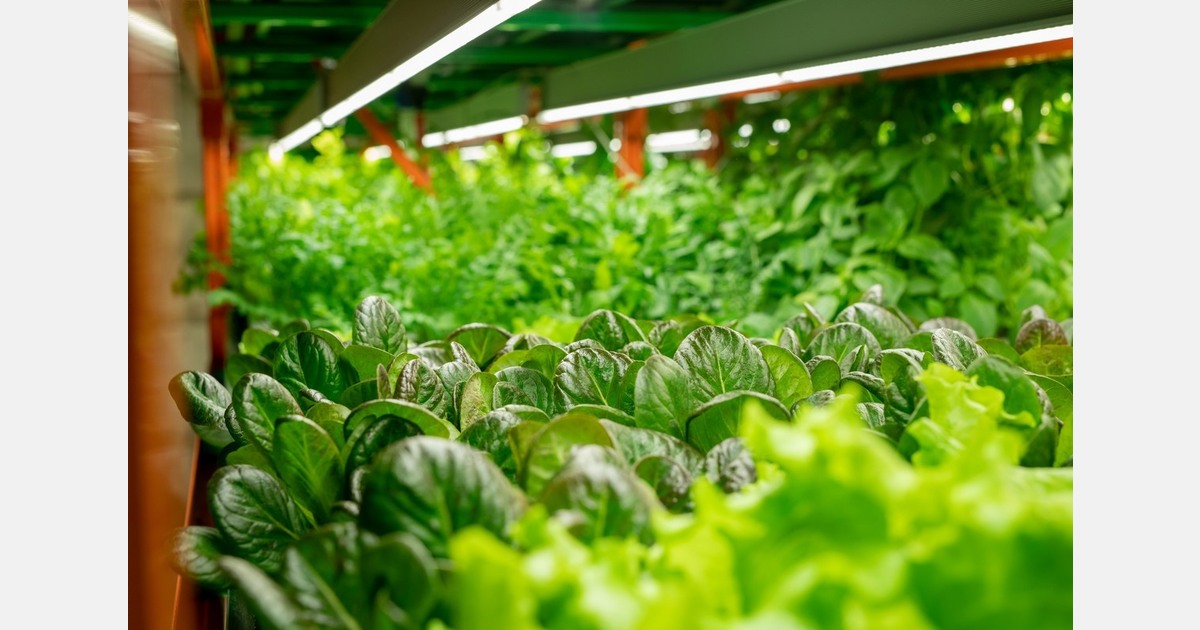
Balancing light in rotating vertical farms

Source: VFD.com
We developed and validated a 3D computational ray-tracing model to create a digital twin of a rotating vertical farm in a greenhouse. The model was validated against empirical microclimate data (R2 = 0.88) and deployed to optimise both static (orientation) and dynamic (rotation) parameters.
A separate theoretical optimisation for the isolated system under open skies revealed a significantly higher potential gain of 13.7%, quantifying the constraining effect of the greenhouse superstructure. Furthermore, dynamic management was highly effective: increasing the rotational speed by 33% reduced the spatial coefficient of variation in daily light integral from 46.1% (static) to 3.8%, effectively eliminating positional disparities.
Source: ResearchGate Frontpage photo: © Johari Mustafa | Dreamstime Publication date: Tue 22 Sep 2026 Related Articles → See More “We found out how low we could go on energy, but the result was a quality issue" Balancing light in rotating vertical farms New free lighting planning tool released for indoor growers "We are a separate, independent company — this news does not affect us" New indoor cultivation light to be introduced at Malaysian agricultural fair Hortilux Schréder declared bankrupt, restart under consideration Lighting: what comes after the efficacy race? "We wanted one SKU that covers more of the site" Denis Dullemans joins MechaTronix as Chief Commercial Officer Four-channel LED spectra target vertical strawberry production Related Articles “We found out how low we could go on energy, but the result was a quality issue" Balancing light in rotating vertical farms New free lighting planning tool released for indoor growers "We are a separate, independent company — this news does not affect us" New indoor cultivation light to be introduced at Malaysian agricultural fair Related Articles Hortilux Schréder declared bankrupt, restart under consideration Lighting: what comes after the efficacy race?
Why this matters: For operators, this is a water-management story. The useful signal is that direct substrate measurements can help cut drain loss materially without giving up yield or fruit quality, which is exactly the kind of controllable efficiency gain a facility can build on.
Frequently Asked Questions
Why does substrate sensing matter in free-drain strawberry systems?
Because drain percentage tells a grower what already happened, while substrate moisture and EC data show root-zone conditions directly. That makes it easier to cut water loss without guessing.
What is the operator takeaway from this trial?
If the thresholds are understood well enough, growers can reduce drain water materially while protecting yield and fruit quality, which makes sensing an operational tool instead of a reporting tool.