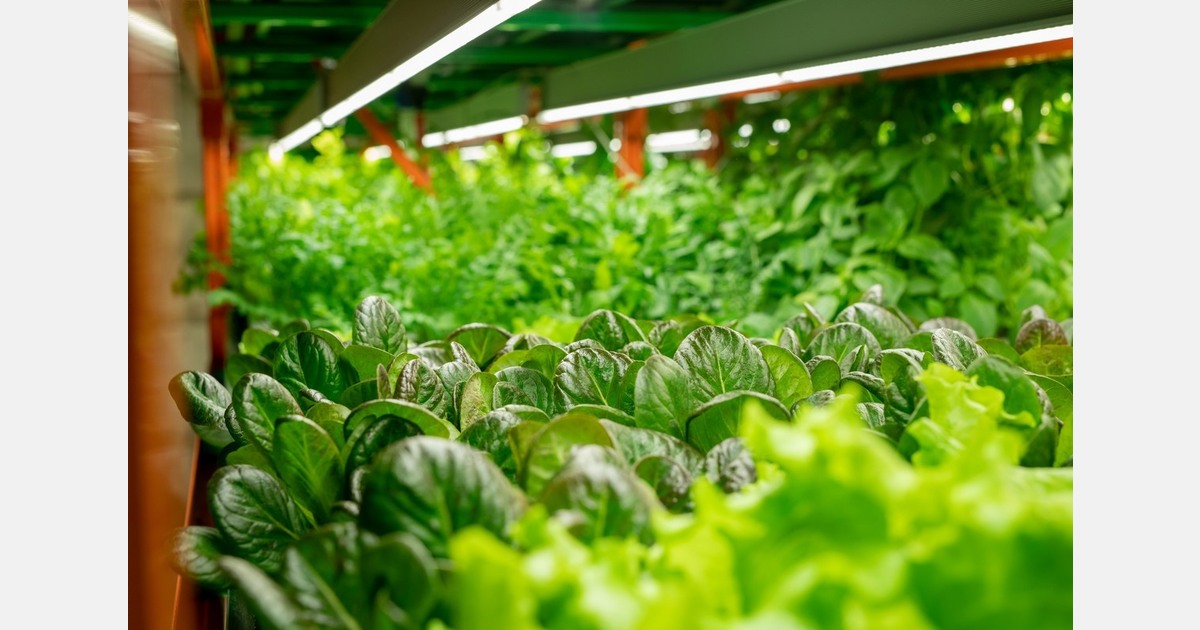
Creating a sensor-driven architecture for resource-efficient hydroponic NFT vertical farming

Source: VFD.com
Creating a sensor-driven architecture for resource-efficient hydroponic NFT vertical farming Urbanization and freshwater stress are intensifying pressure on conventional food systems, motivating closed-environment production. This Short Communication specifies a sensor-driven architecture for hydroponic nutrient film technique (NFT) leafy-green production, comprising an in-situ sensing layer, a three-tier Internet of Things (IoT) data path, and a gradient-boosted decision-tree (GBDT) scheduler.
Three controllers were compared over a single 14-day trajectory under one fixed seed. The GBDT scheduler holds the room inside the target envelope 75.8 percent of the time at 91.3 kWh per day, against a rule-based hysteresis baseline (15.6 percent, 140.1 kWh per day) and a Ziegler-Nichols-tuned proportional-integral-derivative (PID) reference (77.9 percent, 96.8 kWh per day).
On a combined cost J = 10(1 - a) + 0.05E, the scheduler reduces the hysteresis cost by 55 percent, while it and the tuned PID differ by 1.0 percent (6.98 against 7.05), a gap a single replicate cannot resolve. Sensor-Driven Architecture for Resource-Efficient Hydroponic NFT Vertical Farming: A Simulation-Based Controller Evaluation.
Why this matters: For operators, this is a water-management story. The useful signal is that direct substrate measurements can help cut drain loss materially without giving up yield or fruit quality, which is exactly the kind of controllable efficiency gain a facility can build on.
Frequently Asked Questions
Why does substrate sensing matter in free-drain strawberry systems?
Because drain percentage tells a grower what already happened, while substrate moisture and EC data show root-zone conditions directly. That makes it easier to cut water loss without guessing.
What is the operator takeaway from this trial?
If the thresholds are understood well enough, growers can reduce drain water materially while protecting yield and fruit quality, which makes sensing an operational tool instead of a reporting tool.