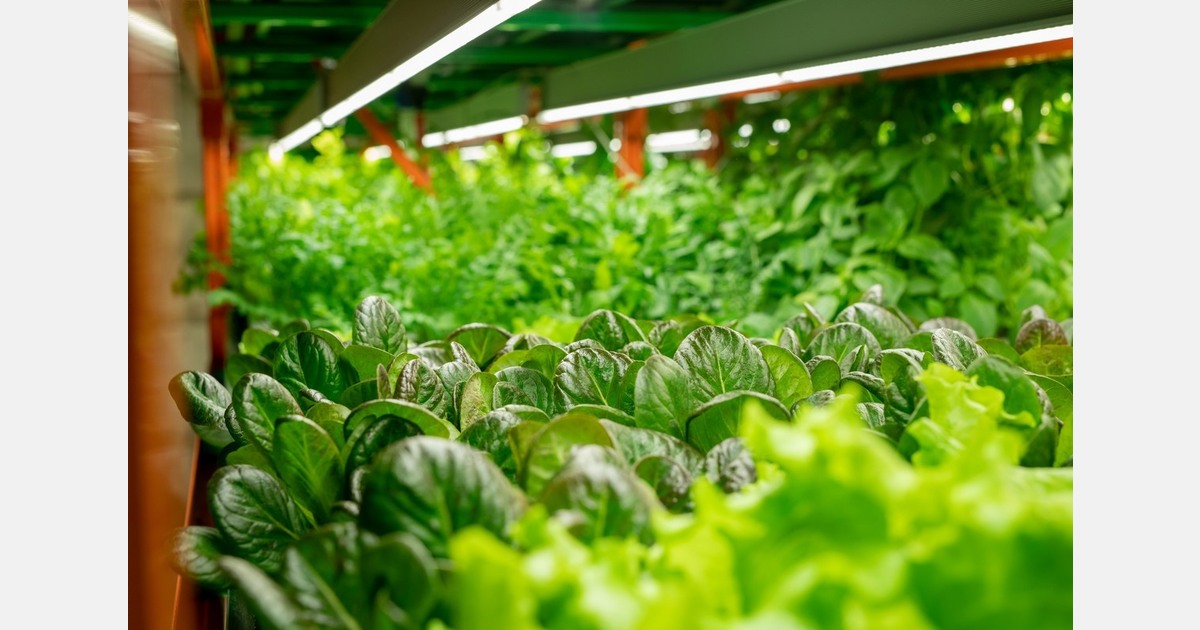
Using organic nanofertilizers in hydroponic lettuce growing

Source: VFD.com
The results reveal that the P2S formulation (75% AB Mix + 25% Sargassum nano-organic fertilizer) produced the highest growth response, achieving 21.20 cm plant height, 7.80 leaves, and 0.37 g dry weight, while the P3G formulation (50% AB Mix + 50% Gamal nano-organic fertilizer) showed comparable performance, particularly in biomass accumulation. Both treatments showed no significant difference compared to the 100% AB Mix control, whereas the use of 100% nano-organic fertilizer led to significant reductions in all growth parameters.
Multivariate analysis further confirmed that P2S and P3G consistently occupied the optimal position in the principal component dimension, indicating their overall superiority in productivity and nutrient efficiency. Nano-organic fertilizers contributed to improved growth performance through enhanced nutrient availability and biostimulant effects, while partial substitution strategy reduced reliance on synthetic fertilizers and utilized locally abundant resources.
These findings highlight that integrating nano-organic fertilizers into hydroponic nutrient management can support sustainable crop production, lower environmental impact, and serve as a viable strategy for both coastal and dryland regions depending on material availability. Overall, the study indicates that a partial substitution of AB Mix with nano-organic fertilizers is an effective approach to sustainable hydroponic lettuce cultivation.
Why this matters: For operators, this is a water-management story. The useful signal is that direct substrate measurements can help cut drain loss materially without giving up yield or fruit quality, which is exactly the kind of controllable efficiency gain a facility can build on.
Frequently Asked Questions
Why does substrate sensing matter in free-drain strawberry systems?
Because drain percentage tells a grower what already happened, while substrate moisture and EC data show root-zone conditions directly. That makes it easier to cut water loss without guessing.
What is the operator takeaway from this trial?
If the thresholds are understood well enough, growers can reduce drain water materially while protecting yield and fruit quality, which makes sensing an operational tool instead of a reporting tool.