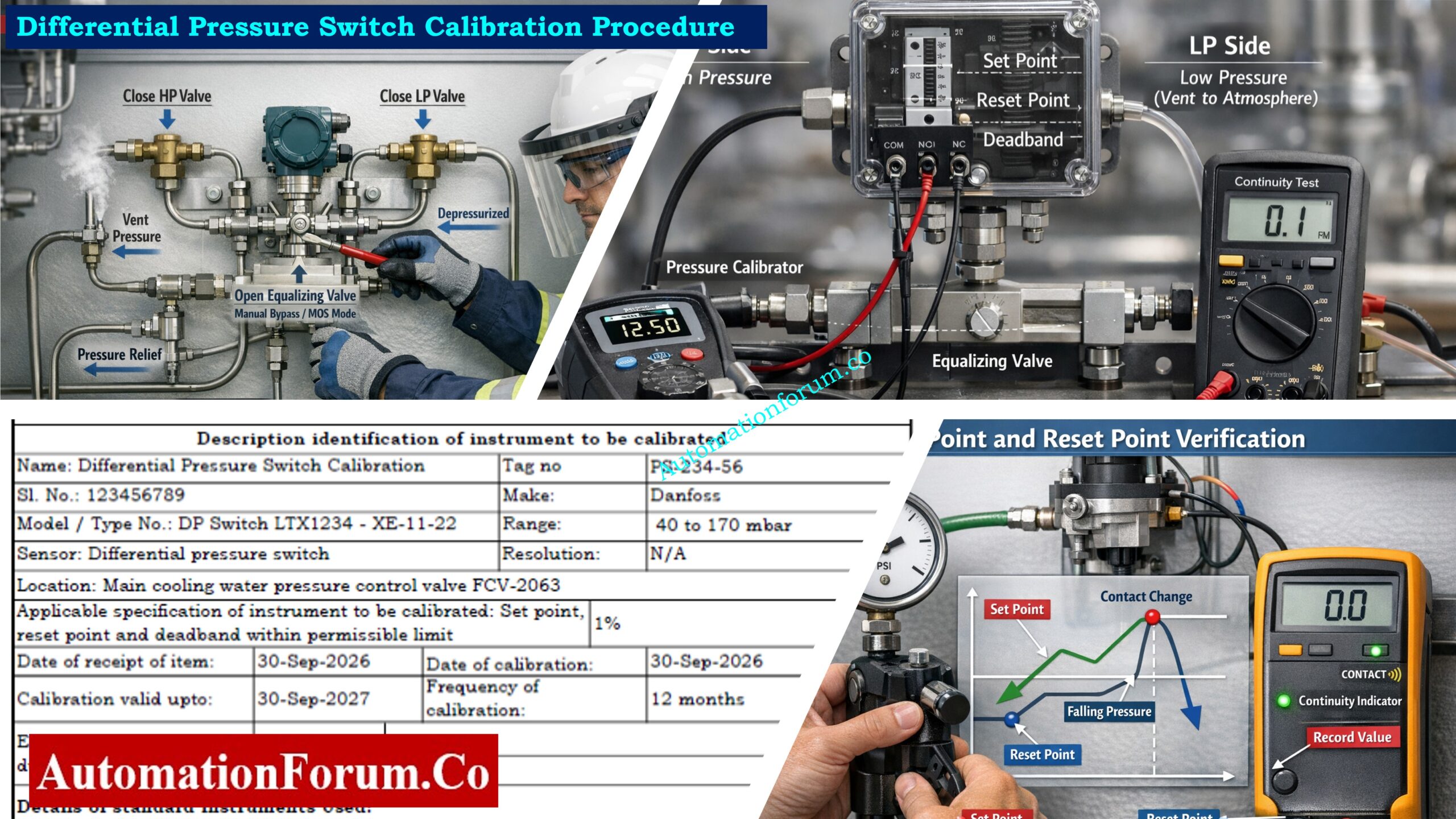
Differential Pressure Switch Calibration Procedure
Source: Instrumentation and Control Engineering
Why Differential Pressure Switch Calibration is Required Tools Required for Differential Pressure Switch Calibration Safety Precautions Before DP Switch Calibration Isolation of the Differential Pressure Switch from Process Ensuring Zero Pressure Condition Differential Pressure Switch Calibration Setup Final Pre Calibration Checklist Step by Step Differential Pressure Switch Calibration Procedure Increasing and Decreasing Differential Pressure Calibration Method Final Calibration Checklist Completion of Differential Pressure Switch Calibration Common Mistakes in Differential Pressure Switch Calibration When Low Pressure Side Atmospheric Method is Not Suitable Sample Differential Pressure Switch Calibration Report Key points to remember for DP switch calibration Frequently Asked Questions About Differential Pressure Switch Calibration What Is a Differential Pressure Switch and How Does It Work? Differential pressure switch working principle A differential pressure (DP) switch is a tool that tells you how different two pressure points are.
The high-pressure (HP) side and the low-pressure (LP) side are the two pressure points that are usually measured. The switch turns on or off an electrical contact based on this differential in pressure.
How A Dp Switch Measures High Pressure And Low Pressure The DP switch operates using a diaphragm or piston mechanism. The difference in pressure between HP and LP makes a force that moves the detecting element, which then turns on an electrical switch.
Why this matters: For operators, the real question is whether the sensing, control, or data layer creates faster and better decisions. The facilities that win are the ones that turn visibility into tighter control and tighter control into better outcomes.
Frequently Asked Questions
What is the difference between forward-acting and reverse-acting control valves?
Forward-acting and reverse-acting valves respond differently to a change in signal or process condition. The right choice depends on fail-safe behavior, process stability, and how the valve should respond under fault conditions, according to the source article.
Why does control valve action matter in greenhouse or facility design?
Valve action affects stability, safety, and controllability. In any engineered environment, choosing the wrong action can make a system harder to tune and more expensive to operate over time.