
Globe vs Ball vs Butterfly Control Valves Complete Comparison Guide for Flow Control Selection and Applications in Process Industries
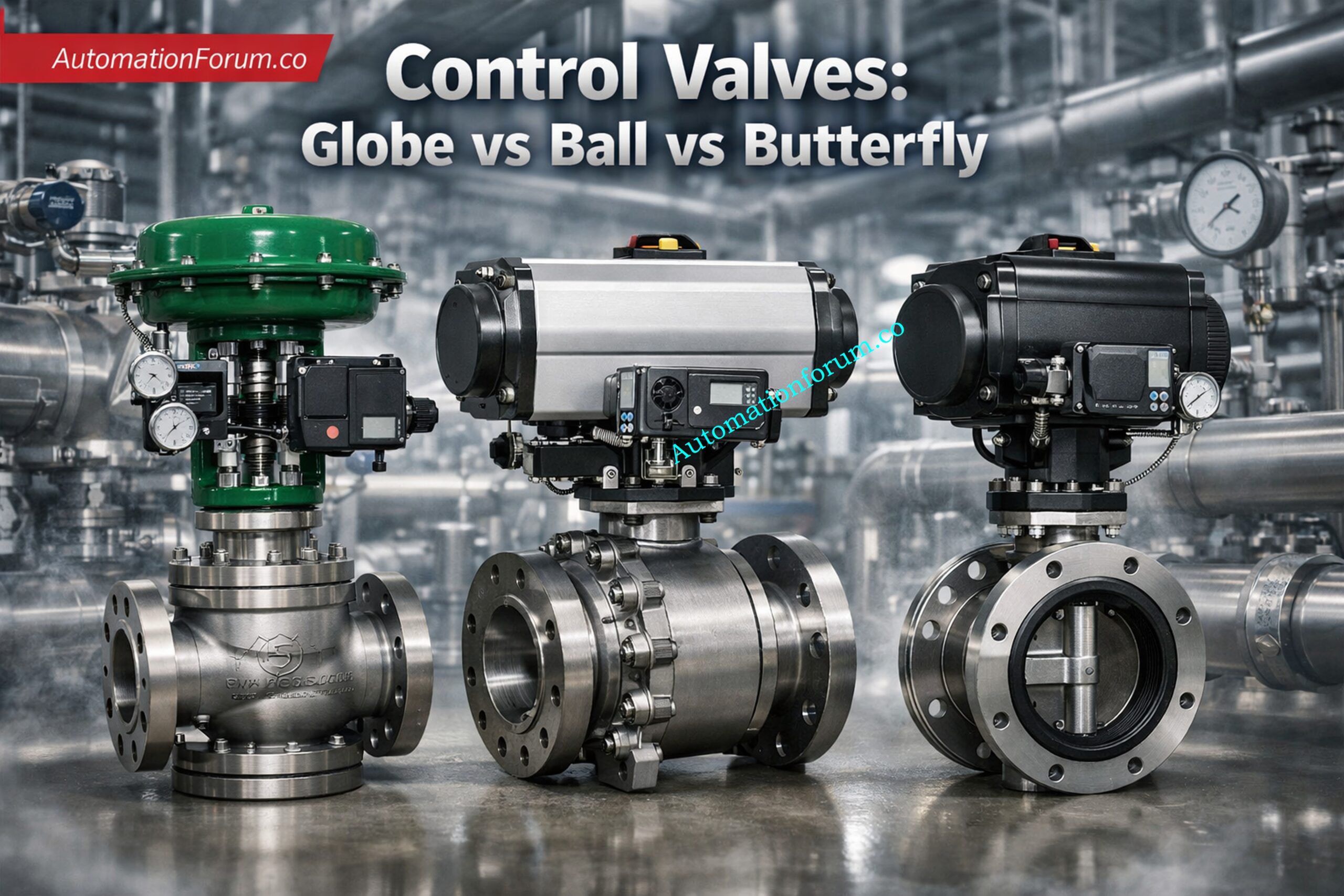
Source: Instrumentation and Control Engineering
Impact of Valve Selection on Energy Efficiency and System Stability Valves are more than just mechanical parts; they have a direct effect on: The stability and reaction time of process control loops. How often maintenance is done and how long the plant is down.
Overview of Globe Ball and Butterfly Valves in Industrial Applications In most industrial applications, engineers must choose between: Globe valve for precision control. Key Challenges in Selecting the Right Control Valve A wrong selection can lead to: Poor PID control tuning and oscillations.
Importance of Control Valve Types Comparison for Engineers To make sure that you know how to compare different types of control valves, you need to: The best precision for flow control. Ultimate Control Valve Body Material Selection Guide: Control Valve Body Material Selection Guide for EPC Design Instrumentation Engineers What is a Globe Valve Working Principle Applications Advantages and Limitations A globe valve is a linear motion valve specifically designed for accurate throttling and continuous flow control.
Why this matters: For operators, the real question is whether the sensing, control, or data layer creates faster and better decisions. The facilities that win are the ones that turn visibility into tighter control and tighter control into better outcomes.
Frequently Asked Questions
What is the difference between forward-acting and reverse-acting control valves?
Forward-acting and reverse-acting valves respond differently to a change in signal or process condition. The right choice depends on fail-safe behavior, process stability, and how the valve should respond under fault conditions, according to the source article.
Why does control valve action matter in greenhouse or facility design?
Valve action affects stability, safety, and controllability. In any engineered environment, choosing the wrong action can make a system harder to tune and more expensive to operate over time.