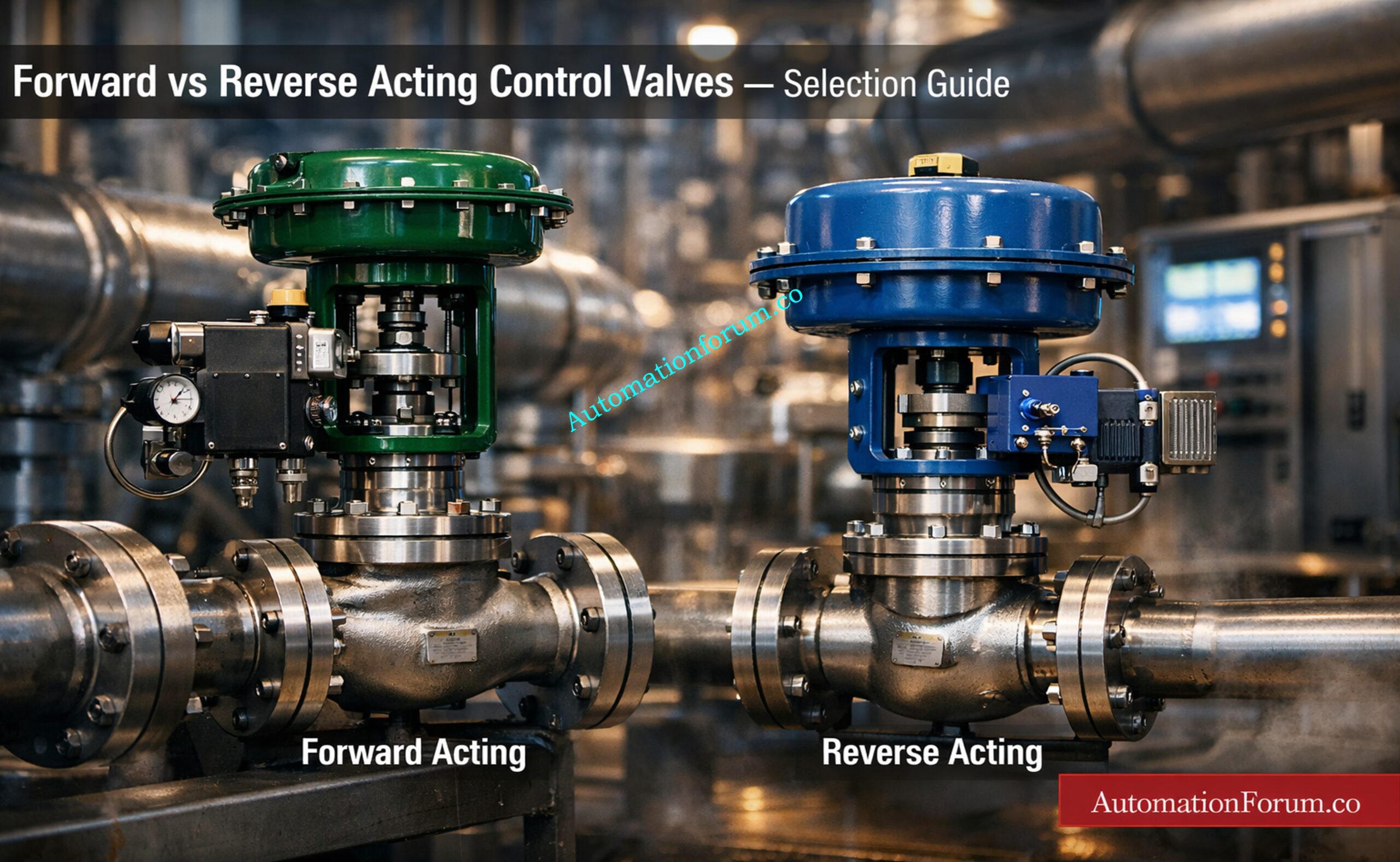
When to Choose Forward and Reverse Acting Control Valves for Design Engineer
Source: Instrumentation and Control Engineering
Table of Contents Forward Acting Control Valve vs Reverse Acting Control Valve: Selection Guide What is Control Valve Action in Process Control Loop Design Air to Open vs Air to Close Valve Explained for Engineers Process Gain and Control Philosophy in Control Valve Selection When to Use Forward Acting Control Valve in Process Industries When to Use Reverse Acting Control Valve in Process Industries Fail Open vs Fail Close Valve Selection Criteria in Instrumentation Engineering Control Loop Stability and Control Valve Action Interaction Practical Control Valve Selection Checklist for Engineers Real Industrial Examples of Control Valve Action Selection Common Mistakes in Control Valve Action Selection How to Select the Right Control Valve Action FAQ on Choose Forward and Reverse Acting Control Valves Forward Acting Control Valve vs Reverse Acting Control Valve: Selection Guide Control valves are the backbone of any process control system. In industries such as oil and gas, petrochemical, power generation, and manufacturing, they act as the final control element that directly influences process variables like flow, pressure, temperature, and level.
When designing a plant in real life, engineers generally spend a lot of time choosing transmitters, setting up controllers, and adjusting PID loops. However, one of the most critical and frequently misunderstood decisions is selecting the correct control valve action.
From field experience, incorrect selection between a forward acting control valve and a reverse acting control valve can result in: Unstable control loops Opposite process response Poor controllability during disturbances Dangerous plant conditions during failure scenarios In EPC projects, it is common to see loop performance issues traced back not to controller tuning, but to incorrect valve action or fail safe configuration. A poorly selected valve can make even a well tuned control loop behave unpredictably.
Understanding valve action is therefore not just a theoretical requirement. It is a practical necessity for safe and stable plant operation.
Why this matters: For operators, the takeaway is not the headline itself. It is whether the underlying sensing, control, or data layer creates a measurable operational advantage. The winners will be the facilities that can turn instrumentation into faster decisions.